

Breathing Lessons
Four years later, are we breathing any easier?

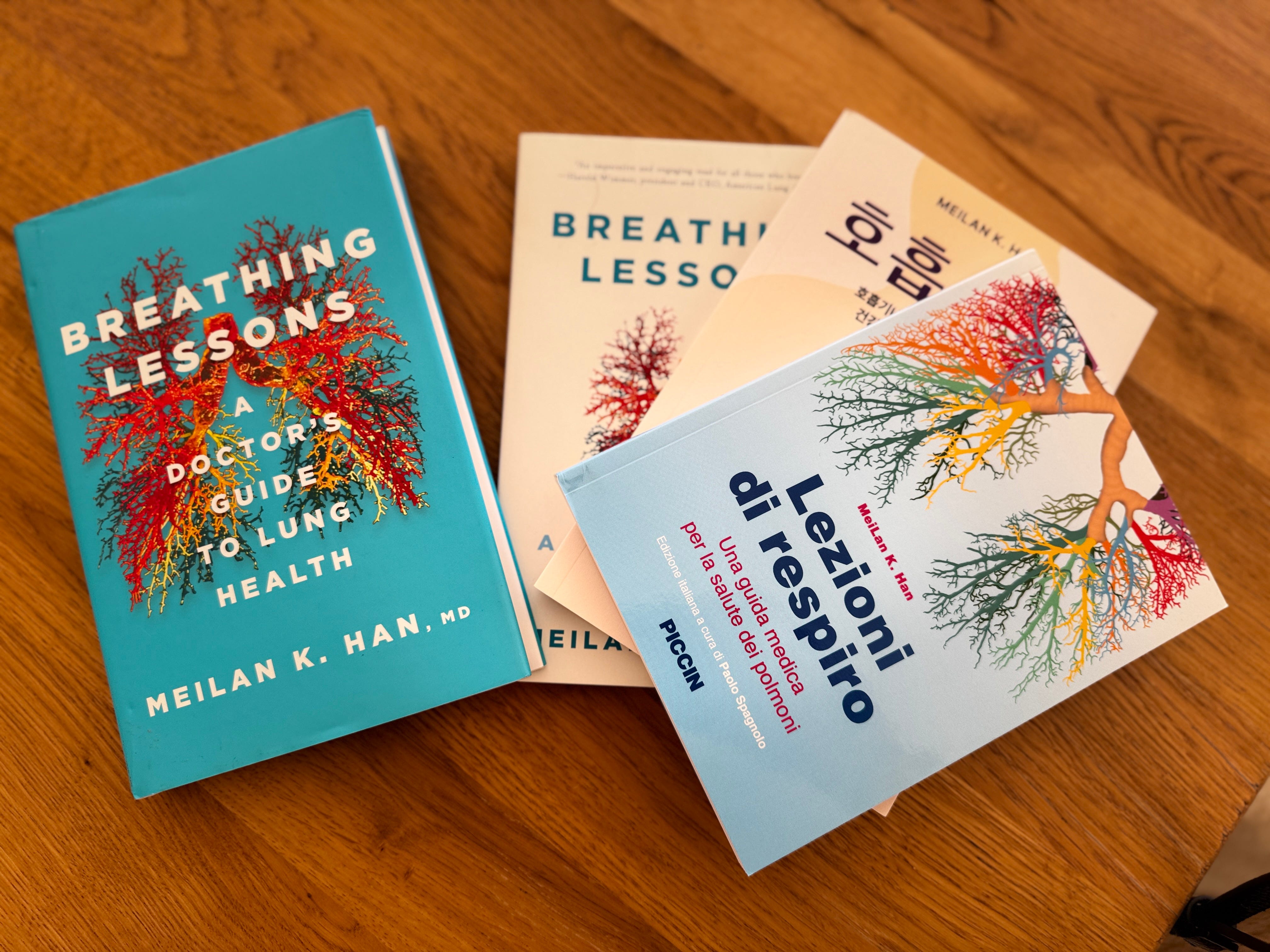
I can’t believe four years and several additional language versions have passed since the launch of Breathing Lessons. For those of you who don’t know the full story, I have been a volunteer spokesperson for the American Lung Association for a long time. But to be honest, the phones were not ringing off the hook. Then the pandemic hit. Suddenly, lots of people had questions about how their lungs worked, what a ventilator was, and why we needed so many of them. I had the opportunity to appear as a guest on the popular radio show and podcast, Freakonomics (episode is linked if you’re curious!).
A month or so later, Matt Weiland, an editor at WW Norton Publishing reached out. He had listened to the podcast and realized there was very little information on how the lungs worked for the lay public. Many of my clinical trials were shut down, so I spent the summer of 2020 writing. The book was published roughly a year later.
When I held the first copy in my hands, I hoped it might spark a broader conversation about lung health—about how these delicate organs sustain us, protect us, and reflect the world we live in. November, fittingly, is COPD Awareness Month, and November 19th is World COPD Day. So it feels like the right time to take stock.
When I wrote Breathing Lessons, my goal was simple: to help people understand how their lungs work, what happens when they don’t, and why it matters so profoundly that we take care of them. I wanted to demystify a part of the body that most of us never think about until it fails us, and to shine a light on the millions quietly living with breathlessness, those with COPD, asthma, pulmonary fibrosis, and other chronic lung conditions who too often feel invisible. I also wanted to examine why, relative to other diseases, we still understand so little about lung injury and repair. We still have far too few treatments for those living with lung disease.
What’s Changed Since Then
On the upside, in the past three years we’ve seen real momentum in respiratory medicine. We’ve seen new targeted biologic therapies approved for both asthma and COPD, including tezepelumab in asthma as well as dupilumab and mepolizumab in COPD. Also in COPD, the arrival of a novel dual PDE3/4 mechanism inhaler gives pulmonologists another new tool beyond classic bronchodilators and steroids. To be clear, we hadn’t had a new class of drug approved for COPD in the preceding decade. The FDA also just approved a new treatment for idiopathic pulmonary fibrosis, nerandomilast, the first new treatment for this disease in over a decade. This past year, the FDA also approved a targeted therapy for bronchiectasis (an abnormal dilation and thickening of the airways), brensocatib. This is the first approved therapy for this disease. As more patients begin to get access to these medications, I’ve been thrilled to see at least some patients really feel and breathe better. We hadn’t had anything new to offer in such a long time. These medications all represent concrete progress that are making a real difference for patients and offering new hope for many. I believe these advances are just the tip of the iceberg.
What Hasn’t Changed—Yet
For all the scientific progress, we are still neglecting the systems that keep our lungs healthy. The CDC continues to lose people and capacity. Surveillance networks have thinned, labs have closed, and the basic infrastructure that should protect us from the next outbreak is weaker than it was four years ago.
Environmental protections have slipped as well. Cuts to the EPA threaten the clean air standards that once seemed nonnegotiable. Dirtier air means more asthma, more heart disease, more preterm births, and more avoidable deaths. These are direct hits to respiratory health.
The NIH also remains under threat. Annual attempts to cut its budget have created an atmosphere of uncertainty that slows discovery and discourages the next generation of scientists. You cannot sustain a world-class research enterprise while steadily eroding its foundation.
And we have watched trust in vaccines fracture. Falling vaccination rates have already led to the return of illnesses we once controlled. The consequences land on patients, families, and health systems that are already stretched.
All of this reflects a larger truth. We still have not committed to protecting the air we breathe or the institutions that safeguard public health. Until we do, the scientific gains of the past few years will remain vulnerable.
If I Were Writing Breathing Lessons Today
If I were writing Breathing Lessons today, I would still begin with the fundamentals. Those lessons of how are lungs work have not changed. But what has shifted, for me, is my sense of how deeply our lungs are connected to everything around them. In 2020, I wrote about environment, inequality, and preparedness as important forces. Today, I would frame them as inseparable from lung health itself. We can no longer talk about how a lung works without talking about the air that fills it, the climate that shapes that air, the community that surrounds the person who inhales it, and the public systems that support those communities. I would also probably spend more time talking about how trust in institutions affects those who seek care, who gets vaccinated, and who carries the greatest burden of disease. Lung health is shaped by biology, environment, access to care, and the choices we make as individuals and as a society. The point I want readers to carry forward is simple. Protecting lung health is not only about understanding physiology. It requires building environments and systems that give every person a fair chance to breathe.